A project intelligence agent for a 250-person studio.
An internal copilot that reads the studio's whole project memory: SharePoint, Teams, project plans and timesheet exports. It answers leadership questions in plain language, with citations, without a byte leaving the tenant.
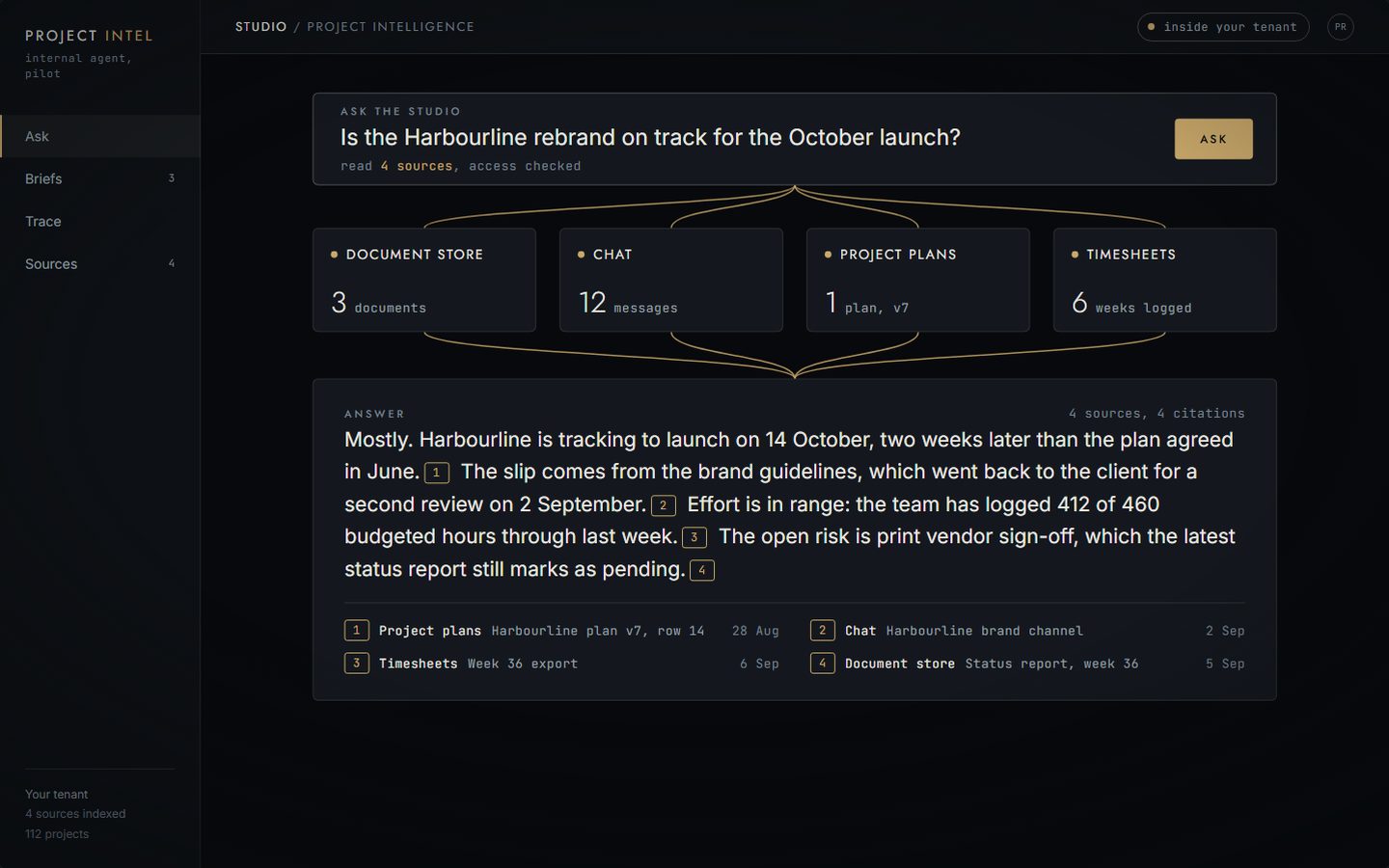
A stylised recreation of the product. Names, figures and documents are illustrative.
Institutional memory that lived in three heads.
The studio runs over one hundred active projects across India and the United States. Leadership relied on weekly status reports, project plans, timesheet exports and the memory of three senior managers. Getting a clear picture of even ten projects took half a day.
The data existed. It lived in SharePoint, Teams, a handful of Excel files and those three heads. Leadership wanted one place to ask what the real state of a project was, get the answer in plain language with citations, and keep all of it inside their own Microsoft tenant.
Eleven weeks. Four phases. One agent.
The first two phases were unglamorous: audit the data estate, design the architecture. That is where most AI projects fail. We refused to skip them.
Audit, before any code
We mapped the data estate. Eleven document libraries, six Teams channels, two timesheet exports, three SharePoint sites. Each source was graded on quality, recency and permissions. The first deliverable was a one-page memo on what to index and what to leave out. Half the data made the cut.
Weeks 1 to 2Architecture that respects access
An indexing pipeline that honours role-based access. A senior manager's questions pull only from documents she may read. A project manager's do not. Tenant isolated. No data, queries or embeddings leave the firm's Microsoft tenant. Every component was chosen for auditability, not novelty.
Weeks 2 to 4Build, evaluate, repeat
The agent, the retrieval layer and the evaluation harness were built in parallel. Every release ran against eighty hand-curated internal questions before going live. We tracked accuracy, citation correctness and refusal quality. Releases that did not improve the scores were rolled back.
Weeks 4 to 9Pilot, then expand
Released to four members of the leadership team, who asked the questions they ask in Monday reviews. The agent answered correctly on the first try in eighty-nine percent of cases, partially in a further seven, and refused on the rest. That is what we wanted. PM teams are being added now.
OngoingMondays look different now.
Leadership starts the Monday review with the agent open. Status reporting time is down. The conversations that follow are better, because everyone reads from the same baseline. Knowledge that sat in three managers' heads is now searchable by everyone who needs it.
The first week I used it, I asked it the questions I had asked my PMs the week before. The answers matched. The difference was speed.Head of Operations · Professional services studio · India and US