Field operations, redesigned for a tier-one operator.
A native iPad experience for thousands of field technicians. Offline first, glove friendly, and built around the real sequence of work rather than the org chart.
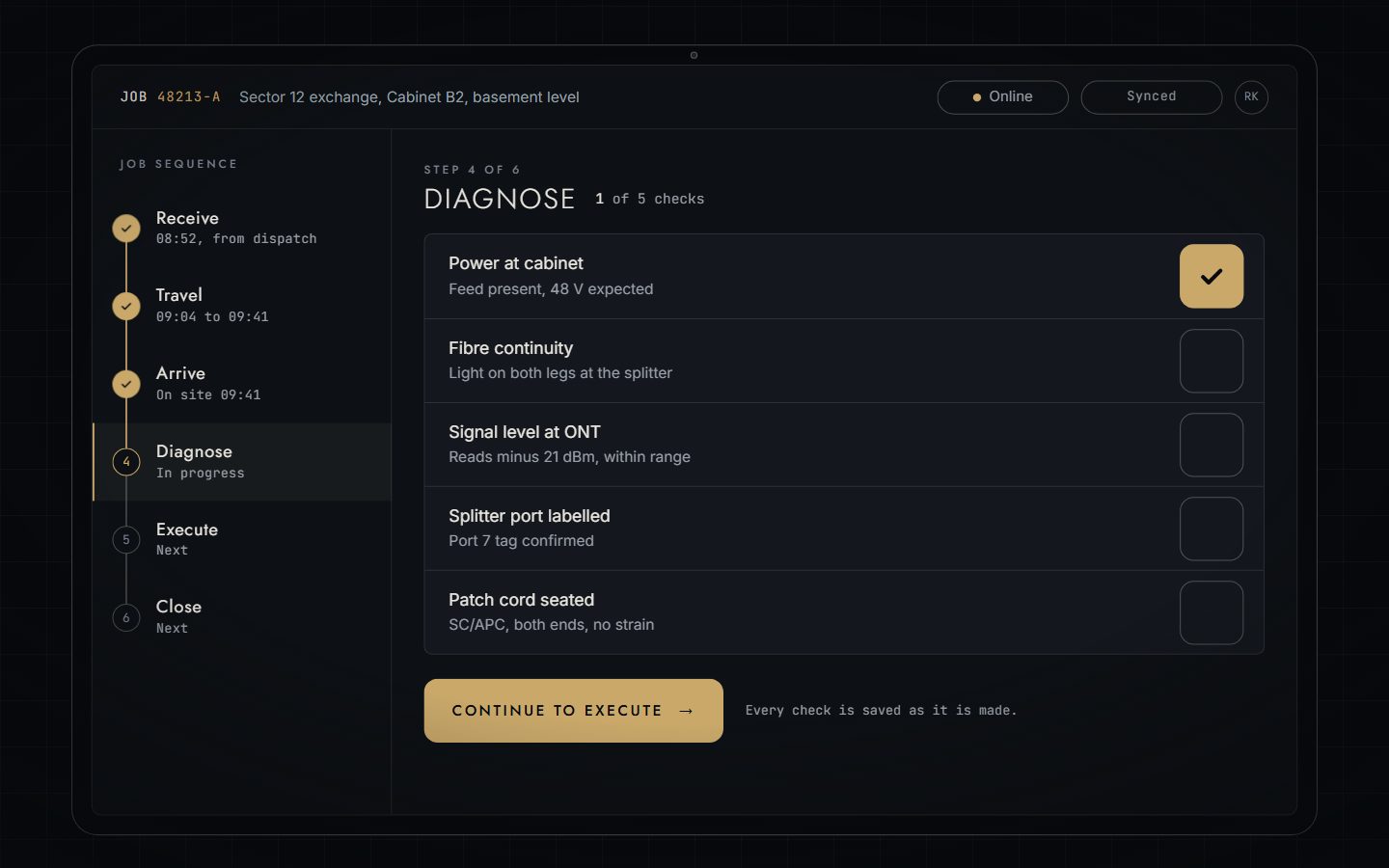
A stylised recreation of the product. Names, figures and documents are illustrative.
Two tools, one technician, built by the wrong people.
Technicians used two tools. A legacy desktop application on a vehicle laptop for job intake, and a mobile app for closing tickets. The two did not talk to each other. Both were built around the org chart, by IT for ops and by ops for IT, rather than around a technician's day.
Leadership had heard enough complaints. They wanted one tool, on one device, designed for the technician in the field. Not an iteration of either system. Not a wrapped web app. A native experience that respected patchy networks, large gloves, harsh sun, and someone with six more tickets to close before lunch.
Twenty-two weeks. Most of them in the field.
We spent more time on the ground than at our desks. The brief looked simple: design a better tool. The first finding from the field broke our own product hypothesis. We listened to the field, not the brief.
Field research, twelve shifts
We rode along with technicians across two regions. Twelve full shifts, six equipment types. We logged every tap, every retry on a patchy network, every workaround the team had invented. The report carried three findings leadership had never heard, and it changed the brief.
Weeks 1 to 4Architecture around the work
We restructured the product around the technician's real sequence: receive the ticket, travel, arrive on site, diagnose, execute, close. The old tools were structured around data models. In the new one, the data model serves the workflow.
Weeks 4 to 8Design and engineering, shoulder to shoulder
Native iPad. Offline-first sync with conflict resolution. A design system built for outdoor readability: high contrast, large hit targets, and no motion that would tire an already tired technician. The engineering pod worked from that same system, so no component ever had two interpretations.
Weeks 8 to 18Pilot, refine, scale
Released to two hundred technicians in two cities, with daily field observation for the first two weeks. The most important change was a redesign of the diagnosis flow we had been confident about. The pilot proved us wrong. The technicians were right.
Weeks 18 to 22The tool stopped being the problem.
One native app replaced both legacy systems. Technicians went from two devices to one, and daily ticket throughput improved. They also stopped raising tool problems in the daily standup, which the field manager had said would be the real measure. The design system now belongs to the operator's own team.
It is the first time IT has built something that respects how we actually work. We stopped having to fight the tool to do the job.Field operations manager · Telecom operator · India